

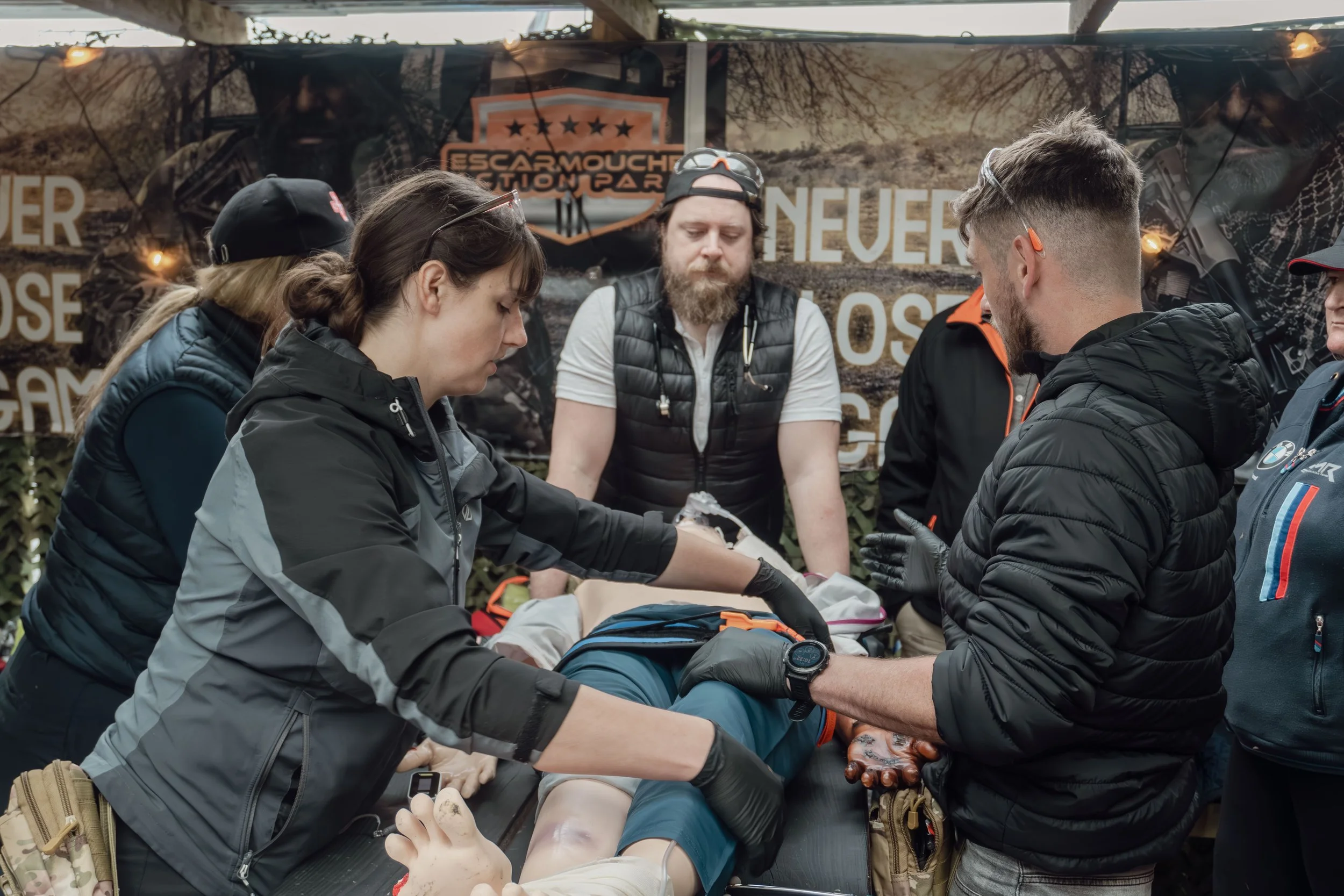
APEX-6: AUSTERE, PROLONGED & EXPEDITIONARY CARE (LEVEL 6)
YEAR 1
NB: All modules prefixed “APEX” are delivered by K2 International. Modules prefixed “RPP” are delivered by CoROM following successful admission to the BSc Remote Paramedic Practice through CoROM’s formal Recognition of Prior Learning (RPL) and admissions processes.
NBB: APEX-6 has been specifically designed and mapped against 90 credits of the BSc Remote Paramedic Practice. K2 International will sponsor and support the learner’s RPL application for these mapped credits. Accordingly, the 90-credit RPL pathway should be regarded as academically assured for learners who successfully complete the relevant APEX-6 requirements. Formal RPL approval remains subject to CoROM’s academic and quality assurance processes, and admission may still be affected by learner-specific matters such as professional conduct, suitability or other admissions requirements.
summary of modules
-
NB: All modules listed are compulsory for completion of Year 1.
Classroom guided learning: 378 hours
Online guided learning: 225 hours
Self-directed learning: 186 hours
Clinical placement: 750 hours
Total: 1539 hours or ~192 days (assuming 8-hour days)
-
COMPULSORY
20 Hours classroom
35 Hours self-directed learning
3x OSCEs
Professional Practice Portfolio assessment
Learner Workbook assessment
This module introduces the professional role, responsibilities and expectations of an Emergency Medical Technician. Learners develop their understanding of communication, teamwork, human factors, clinical decision-making, reflective practice, academic writing, research skills and evidence-based practice in pre-hospital and urgent care.
-
COMPULSORY
50 Hours classroom
40 Hours self-directed learning
2x OSCEs
1x Skills test
Professional Assessment Document assessment
Learner Workbook assessment
This module develops the core assessment and emergency care skills required for safe EMT-level practice. Learners cover structured patient assessment, scene management, ECG acquisition and interpretation, airway management, intermediate life support, post-ROSC care, clinical reasoning and the non-technical skills needed to work safely in emergency settings.
-
COMPULSORY
40 Hours classroom
42 Hours self-directed learning
Invigilated exam (written)
Professional Assessment Document assessment
Learner Workbook assessment
This module builds the learner’s understanding of human anatomy, physiology and common pathophysiology in emergency and urgent care. It focuses on applying body systems knowledge to patient assessment, clinical decision-making, recognition of deterioration, sepsis, meningitis and appropriate escalation or referral.
-
COMPULSORY
20 Hours classroom
22 Hours self-directed learning
1x OSCE
Professional Assessment Document assessment
Learner Workbook assessment
This module focuses on the assessment and management of patients who may require adapted approaches to care. Topics include maternity and childbirth, obstetric and gynaecological complications, frailty, delirium, disability, end-of-life care, palliative emergencies and communication with patients and families in sensitive clinical situations.
-
COMPULSORY
20 Hours classroom
20 Hours self-directed learning
Invigilated exam (written)
Professional Assessment Document assessment
Learner Workbook assessment
This module introduces the safe and lawful use of medical gases and lifesaving medications at EMT level. Learners cover medicines legislation, pharmacology principles, patient and medication safety checks, oxygen, nitrous oxide, common lifesaving medicines, adverse reactions, documentation and escalation to senior clinicians.
-
COMPULSORY
30 Hours classroom
27 Hours self-directed learning
1x OSCE
Professional Assessment Document assessment
Learner Workbook assessment
-
COMPULSORY
48 hours classroom
Invigilated exam (written)
1x OSCE
This module extends EMT-level practice into remote and resource-limited environments. It supports learners to apply emergency care knowledge in settings where clinical support may be delayed, resources may be limited and decisions may require careful escalation, remote consultation and ongoing patient reassessment.
-
COMPULSORY
150 Hours classroom
225 Hours online guided learning
Periodic reflective practice case studies
Periodic online exams
This module introduces the professional role, responsibilities and expectations of an Emergency Medical Technician through to Paramedic Level Practice. Learners develop their understanding of communication, teamwork, human factors, clinical decision-making, reflective practice, academic writing, research skills and evidence-based practice in pre-hospital and urgent care.
-
COMPULSORY
750 Hours
Final reflective paper
Portfolio assessment
This module allows learners to develop and evidence their clinical practice in supervised placement environments. Learners record attendance, clinical exposure, skills development, professional behaviours and reflective practice, building a portfolio of evidence to support their progression through the pathway.
YEAR 2
-
NB: All modules listed are compulsory for completion of Year 2.
Classroom guided learning: 160 hours
Online guided learning: 1091 hours
Clinical placement: 375 hours
Total: 1,646 hours or ~206 days, (assuming 8-hour days)
-
COMPULSORY
198 Hours online guided learning
53 Hours classroom
Invigilated exam (written)
1x OSCE
This module introduces tropical, wilderness, expedition and austere medicine, with a focus on the common injuries, illnesses and infectious diseases encountered in remote clinical settings. Learners develop practical approaches to assessment, treatment, field diagnostics, public health awareness and prolonged field care.
-
COMPULSORY
198 Hours online guided learning
53 Hours classroom
Invigilated exam (written)
1x OSCE
Learner Workbook assessment
This module builds on the foundations of tropical and austere medicine, exploring more advanced infectious disease management, treatment options, assessment techniques and clinical decision-making in resource-limited environments. It also develops the learner’s ability to manage teams, reflect on practice and respond creatively to complex remote healthcare problems.
-
COMPULSORY
198 Hours online guided learning
53 Hours classroom
Invigilated exam (written)
1x OSCE
This module focuses on the assessment and management of critically ill patients in remote and austere environments. Learners cover critical care monitoring, haemodynamic instability, shock, burns, blood gas analysis, advanced airway considerations, delayed evacuation and the practical challenges of managing high-acuity patients with limited resources.
-
COMPULSORY
122 Hours online guided learning
x10 online exams
This module develops the learner’s ability to assess and manage minor illness, minor injuries and urgent presentations in remote and austere settings. It focuses on structured clinical assessment, focused examination, safe treatment, suturing and wound care, ongoing care and professional management of patients who may not have immediate access to definitive healthcare.
-
COMPULSORY
125 Hours online guided learning
Online exam
This module introduces the use of basic clinical laboratory techniques in remote and resource-limited environments. Learners explore laboratory safety, basic equipment, field diagnostics, common tests and the practical considerations involved in setting up and using a small clinical laboratory to support clinical decision-making.
-
COMPULSORY
125 Hours online guided learning
Online exam
This module focuses on the common illnesses and injuries seen in remote clinics and austere healthcare settings. Learners develop their ability to assess, prioritise and manage patients using remote medical life support principles, clinical reasoning, basic diagnostics and ongoing reassessment.
-
COMPULSORY
125 Hours online guided learning
Online exam
This module introduces the principles of healthcare delivery in wilderness and expedition environments. Learners consider environmental risk, expedition planning, common wilderness presentations, remote patient care, evacuation challenges and the practical limitations of delivering healthcare away from conventional clinical support.
-
COMPULSORY
375 Hours
Final reflective paper
Portfolio assessment
This module allows learners to apply Year 2 knowledge and skills in supervised clinical practice. It supports the development of advanced assessment, treatment, reflection, clinical judgement and professional portfolio evidence in preparation for higher-level remote paramedic practice.
NB: RPP308, RPP310, RPP311, and RPP312 are compulsory modules equating to 40 credits. Learners must therefore select an additional 4 elective modules to reach the 60 credits required to complete Year 3.
YEAR 3
-
Compulsory guided learning: 625 hours
Elective guided learning: Up to 875 hours
Clinical placement: 375 hours
Total: Up to 1875 hours depending on electives chosen or ~235 days, (assuming 8-hour days)
-
ELECTIVE
5 Credits
125 Hours online guided learning
Invigilated exam (written)
1x OSCE
This module focuses on the assessment and management of the unwell traveller, alongside travel risk management and health and safety in remote workplaces. Learners explore travel-related illness, prevention advice, water safety, food safety, workplace safety and practical strategies to reduce health risks before and during deployment.
-
ELECTIVE
5 Credits
125 Hours online guided learning
Online exam
This module introduces the role of the special operations medic in remote, austere and resource-limited environments. Learners explore tactical medical considerations, the care of critically injured casualties, improvised critical care, pharmacology, physiology and the challenges of supporting medical care in special operations contexts.
-
ELECTIVE
5 Credits
125 Hours online guided learning
Online exam
This module combines disaster medicine with public health principles for remote and austere environments. Learners consider disaster response, casualty management, public health threats, disease prevention, ethical issues and the role of healthcare practitioners in supporting communities during major incidents or resource-limited emergencies.
-
ELECTIVE
5 Credits
125 Hours online guided learning
Online exam
This module develops advanced understanding of tropical disease in remote practice. Learners explore tropical disease pathophysiology, assessment, laboratory diagnosis, treatment strategies, public health implications and decision-making where diagnostic support or definitive care may be limited.
-
ELECTIVE
5 Credits
125 Hours online guided learning
Online exam
This module introduces the principles of diving and marine medicine, including diving physiology, marine hazards, diving-related illness and emergency management in marine environments. Learners also consider diver monitoring, fitness to dive, accident prevention and the management of casualties during diving or maritime operations.
-
ELECTIVE
5 Credits
125 Hours online guided learning
Online exam
This module focuses on the assessment, treatment and prevention of altitude-related illness. Learners explore the physiology of altitude, acute mountain sickness, high-altitude pulmonary oedema, high-altitude cerebral oedema, acclimatisation, evacuation decisions and remote management strategies.
-
ELECTIVE
5 Credits
125 Hours online guided learning
Online exam
This module introduces the retrieval and transport of critically ill or injured patients by air, with a focus on extreme altitude environments. Learners explore aviation physiology, pre-flight assessment, clinical logistics, patient packaging, transport medicine and the risks associated with rotary-wing or fixed-wing retrieval.
-
COMPULSORY
10 Credits
125 Hours online guided learning
Online exam
This module builds advanced pharmacology knowledge for remote paramedic practice. Learners explore drug action, routes of administration, major drug classes, antibiotics, medication safety, adverse reactions, formulary use, clinical limitations and the role of medical oversight in medication-related decisions.
-
ELECTIVE
5 Credits
125 Hours
Online exam
This module introduces the use of ultrasound in remote and resource-limited clinical practice. Learners develop knowledge of ultrasound physics, scanning principles, equipment use, patient communication, clinical indications and the use of ultrasound to support assessment of the critically ill or injured patient.
-
COMPULSORY
15 Credits
250 Hours online guided learning
Online exam
This module introduces healthcare research skills and academic enquiry. Learners develop their ability to source and appraise academic literature, assess bias, understand research methodology, reference correctly, avoid plagiarism and apply evidence to remote, austere and pre-hospital healthcare practice.
-
COMPULSORY
15 Credits
375 Hours
Portfolio assessment
Academic reflection
This module provides supervised clinical practice and professional portfolio development at remote paramedic practice level. Learners consolidate practical and academic learning, develop clinical confidence, evidence remote paramedic skills and reflect on their performance in preparation for professional progression.
-
COMPULSORY
15 Credits
250 Hours
Online submission
This module allows learners to complete a supervised dissertation on a topic related to pre-hospital, remote, austere or trauma care. It develops academic writing, research, referencing, critical thinking and the ability to explore a relevant clinical or professional question in depth.