

The ambulance career ladder: from first responder to consultant paramedic
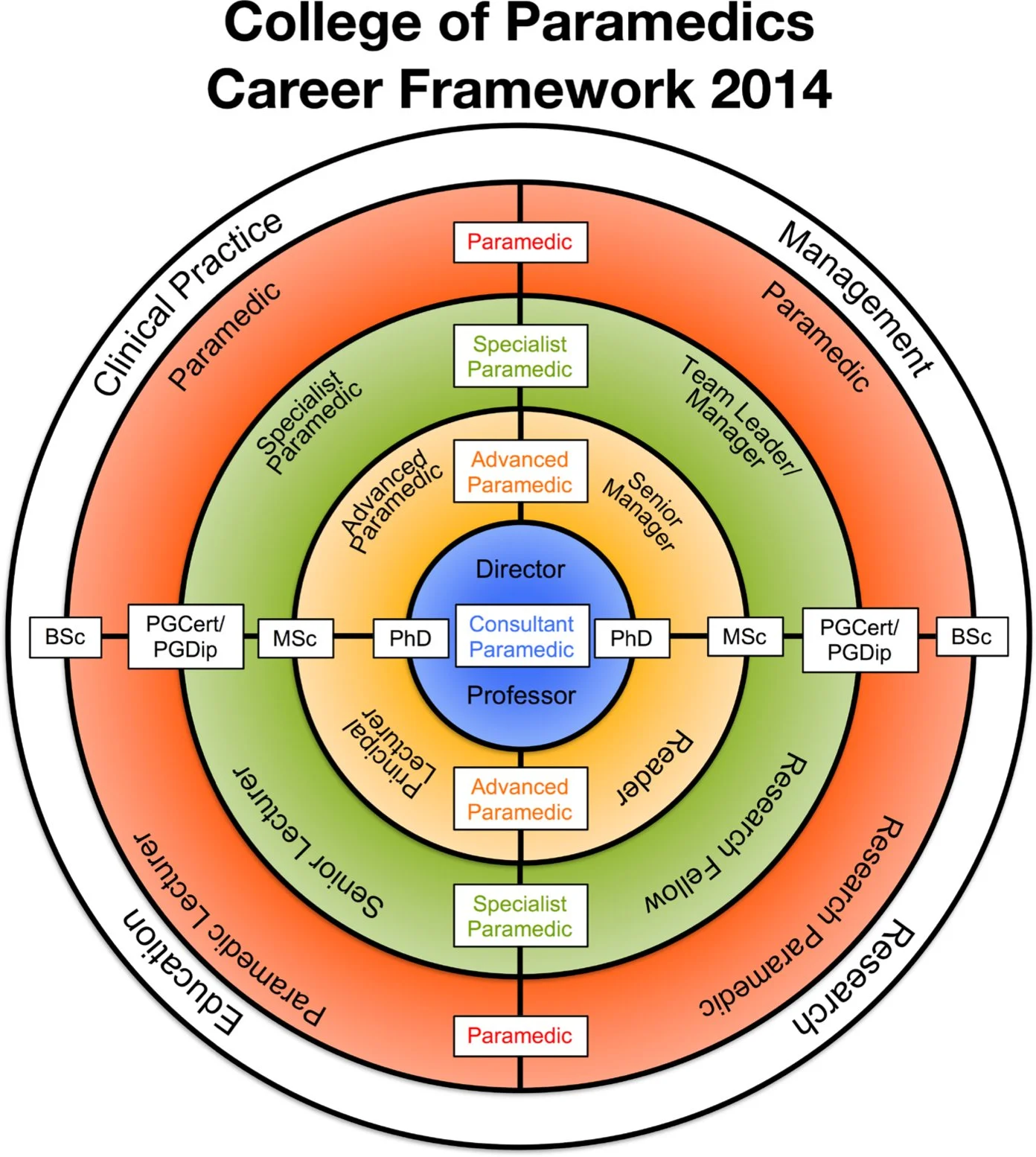
The College of Paramedics Career Framework 2014
Starting a career in ambulance work can feel confusing because job titles, qualifications and scopes of practice are not always used in the same way across the NHS, independent ambulance services, event medical providers and expedition medicine.
One organisation may use the title Emergency Care Assistant. Another may use Ambulance Support Worker. Some services still use Emergency Medical Technician, while others use Associate Ambulance Practitioner. The important thing is not just the job title, but the level of education, clinical responsibility, governance and experience behind the role.
This guide gives a simple overview of the ambulance career ladder from Level 3 through to Level 8.
LEVEL 3:
Level 3 is often the entry point into pre-hospital and ambulance care.
At this level, people may work as first responders, event medics, ambulance care assistants, patient transport staff, ambulance support workers or emergency care assistants, depending on the employer and setting.
The focus is usually on safe initial assessment, basic life support, oxygen therapy, trauma care, medical emergencies, moving and handling, patient communication and supporting a more senior clinician.
Common Level 3 courses and routes include:
-
Community First Responders usually operate in a voluntary capacity. Once enrolled with a CFR scheme, they are often expected to complete around 3 to 5 days of training, depending on the organisation, ambulance service or local governance arrangements.
CFRs may be awarded a scheme-specific qualification, or one of several recognised Level 3 first responder qualifications, such as:
Qualsafe Level 3 Award for Community First Responders (RQF)
Qualsafe Level 3 Award in First Response Emergency Care (RQF), commonly known as FREC 3
FAQ Level 3 Award for First Responders on Scene: Emergency First Responder
FAQ Level 3 Award for First Responders on Scene: Ambulance Service Community Responder
FAQ Level 3 Award for First Responders on Scene: Ambulance Service Co-Responder
FAQ Level 3 Award in Principles of Ambulance Service First Responder Care (RQF)
FAQ Level 3 Award in Immediate Emergency Care: Fire and Rescue
QNUK Level 3 Award for the First Person on Scene (International) (RQF), commonly known as FPOSi
Highfield Level 3 Award in Emergency Care for First Responders (RQF)
NB: Of these, the Qualsafe Level 3 Award in First Response Emergency Care (FREC 3) is probably the most widely recognised and commonly accepted qualification for people looking to work or volunteer as a first responder, particularly in event medical, community response, security and wider pre-hospital care settings. However, individual organisations and ambulance services may have their own preferred qualifications, internal training requirements and governance arrangements.
-
First responders generally work in a paid capacity at events such as concerts, festivals, fairs and sporting events. The role may also form part of another job, such as close protection, security, industrial response, quarry management or other higher-risk workplace roles.
First responders are generally expected to hold one of the following Level 3 qualifications, which are usually delivered over around 4 to 5 days:
Qualsafe Level 3 Award in First Response Emergency Care (RQF), often called FREC 3
QNUK Level 3 Award for First Responders (RQF)
QNUK Level 3 Award for the First Person on Scene (International) (RQF), often called FPOSi
FAQ Level 3 Award for First Responders on Scene: Emergency First Responder
FAQ Level 3 Award in Immediate Emergency Care: Fire and Rescue
NB: Of these courses, the Qualsafe Level 3 Award in First Response Emergency Care, or FREC 3, is probably the most widely recognised and commonly accepted qualification for people looking to work or volunteer as a first responder. However, individual employers, event medical providers, ambulance services and contracting organisations may have their own preferred qualifications, governance requirements and scope of practice.
-
Ambulance Care Assistants, sometimes called Ambulance Care Attendants or Patient Transport Service staff, usually work in non-emergency ambulance roles. They may transport patients to and from hospital appointments, support hospital admissions and discharges, assist elderly or vulnerable patients, and provide basic patient care during transport.
Ambulance Care Assistants are often trained directly by their employer or ambulance service. Where an external qualification is used, it may include one of the following Level 3 qualifications:
Qualsafe Level 3 Award in First Response Emergency Care (RQF), often called FREC 3
Qualsafe Level 3 Award in Non-Emergency Patient Transport Support (RQF)
Qualsafe Level 3 Certificate in Ambulance Patient Care: Urgent Care Services (RQF)
FAQ Level 3 Award in Ambulance Patient Care: Non-Urgent Care Services
FAQ Level 3 Certificate in Ambulance Patient Care: Non-Urgent Care Services
FAQ Level 3 Certificate in Ambulance Patient Care: Urgent Care Services
Trust-delivered ACA / Ambulance Care Attendant training
NB: Of these routes, the most role-specific qualifications for Ambulance Care Assistant or Ambulance Care Attendant work are usually the Level 3 Award or Certificate in Ambulance Patient Care: Non-Urgent Care Services, or the Qualsafe Level 3 Award in Non-Emergency Patient Transport Support. FREC 3 is widely recognised in first responder and event medical settings, but it is not specifically an ambulance care assistant or patient transport qualification. Many NHS and private ambulance providers also deliver their own internal ACA or Patient Transport Service training, which may be accepted instead of, or alongside, an external qualification.
Level 3 roles are a strong first step, but they are still entry-level clinical roles. Having a Level 3 qualification does not make someone a paramedic, and it should always be practised within an agreed scope of practice and clinical governance framework.
Level 4:
EMTs can sit at either Level 4 or Level 5, depending on the qualification route, employer and scope of practice. A Level 4 EMT may be an Associate Ambulance Practitioner or a legacy IHCD Ambulance Technician, while some modern EMT routes sit at Level 5.
Level 4 is usually where ambulance practice becomes more structured and clinically developed.
At this level, people may work as Emergency Care Assistants, Intermediate Ambulance Practitioners, Ambulance Technicians or Associate Ambulance Practitioners. The exact title depends on the employer, qualification route and local governance.
A Level 4 practitioner will normally have a broader understanding of anatomy and physiology, patient assessment, observations, ECG monitoring, medical gases, trauma, medical emergencies, medicines within scope, safeguarding and working as part of an ambulance crew.
Common Level 4 courses and routes include:
-
Emergency Care Assistants, sometimes called Emergency Care Support Workers or Intermediate Ambulance Practitioners, usually work as part of an emergency or urgent care ambulance crew. They may support a paramedic, technician or senior clinician with observations, basic life support, moving and handling, equipment preparation and patient care.
Common qualifications for ECA or IAP-style roles may include:
Qualsafe Level 4 Certificate in First Response Emergency Care (FREC 4)
FAQ Level 4 Certificate in Intermediate Response Emergency Care (RQF)
Trust-delivered Emergency Care Assistant or Emergency Care Support Worker training
NB: FREC 4 is probably the most widely recognised private-sector qualification for ECA or IAP-style work. However, ambulance providers may also prefer the Level 3 Diploma in Ambulance Emergency and Urgent Care Support, especially where the role involves working on an emergency ambulance.
-
Associate Ambulance Practitioners, often called AAPs, are commonly considered to sit at EMT level. They usually work as part of an emergency or urgent care ambulance crew and may assess, treat and convey patients under the governance of an NHS or private ambulance provider.
The recognised qualification for this role is:
Qualsafe Level 4 Diploma for Associate Ambulance Practitioners (RQF)
FAQ Level 4 Diploma for Associate Ambulance Practitioners (RQF)
NB: Unlike first responder, ambulance care assistant or ECA roles, there are not several common qualification options for AAP. The recognised route is the Level 4 Diploma for Associate Ambulance Practitioners, awarded by either Qualsafe Awards or FutureQuals. Delivery is considerably longer than short first responder courses, with classroom training generally around 55 days and approximately 750 hours of clinical practice placement also required. Providers may also require C1 entitlement, emergency response driving, local induction, supervised practice and employer-specific governance before someone can work independently in the role.
-
Ambulance Technicians, often referred to as EMTs, are a legacy ambulance role from the former IHCD route. They were traditionally trained through the IHCD Ambulance Aid / Ambulance Technician pathway, often with IHCD ambulance driving completed alongside it.
This route is no longer a normal training pathway for new entrants, but existing IHCD Ambulance Technicians may still be recognised by NHS ambulance services and private ambulance providers.
The legacy qualification was commonly known as:
IHCD Level 4 Award in Ambulance Aid
or
Pearson / Edexcel BTEC Level 4 Award in Ambulance Aid
NB: Ambulance Technicians are generally considered to sit at EMT level. Although new IHCD technicians are no longer being trained, existing IHCD-qualified technicians may still work in technician or EMT roles where their qualification, experience, emergency driving and current competence are accepted by the employer.
For many people, Level 4 is the bridge between first responder work and more advanced ambulance practice. It is also a common stepping stone towards paramedic training.
Level 5:
Level 5 sits above the traditional first responder and ambulance support worker levels. In the independent ambulance, event, remote, expedition and private medical sector, this level is often associated with Emergency Medical Technician or higher-level pre-hospital practitioner roles.
The exact use of the title EMT varies. In some NHS services, staff called EMTs may complete Level 4 Associate Ambulance Practitioner training. In other sectors, EMT may be used for Level 5 practice. This is why it is important to look at the actual qualification, scope of practice and governance, not just the title.
Common Level 5 courses and routes include:
-
Level 5 is where some EMT-level practice becomes more developed and begins to move into emergency and urgent care associate practitioner roles.
A FREUC 5 practitioner is usually an experienced pre-hospital clinician working in emergency, urgent care, event medical, remote, industrial or private ambulance settings. They may assess and manage a wider range of medical and traumatic emergencies, support clinical decision-making, work alongside registered healthcare professionals and practise under an employer’s clinical governance.
The recognised qualification for this route is:
Qualsafe Level 5 Diploma in First Response Emergency and Urgent Care (RQF), often called FREUC 5
NB: FREUC 5 is a Level 5 EMT-level qualification and is only awarded by Qualsafe Awards. The qualification includes a substantial clinical practice element, with 750 clinical practice hours commonly required as part of the route. It is not a paramedic qualification and does not lead to HCPC paramedic registration on its own. It should be understood as an advanced EMT / associate practitioner level route within pre-hospital emergency and urgent care.
Level 6
Paramedics are registered healthcare professionals regulated by the Health and Care Professions Council (HCPC). They work across emergency, urgent, primary, remote and specialist care settings, assessing, treating, referring and discharging patients within their scope of practice.
For new UK paramedics and specialist paramedics, the minimum approved route is now Level 6, usually through an HCPC-approved degree such as:
-
Paramedics are registered healthcare professionals regulated by the Health and Care Professions Council (HCPC). They work across emergency, urgent, primary, remote and specialist care settings, assessing, treating, referring and discharging patients within their scope of practice.
For new UK paramedics, the minimum approved route is now Level 6, usually through an HCPC-approved degree such as:
BSc Paramedic Practice
BSc Paramedic Science
BSc Remote Paramedic Practice, where accepted through an appropriate international application or registration route
NB: Older paramedic routes did exist below Level 6, including legacy IHCD routes and more recent Foundation Degree routes. These were previously accepted routes into paramedic registration, but they are no longer the minimum standard for new HCPC-approved paramedic education programmes. Since 1 September 2021, the HCPC threshold for entry to the paramedic register has been a Bachelor’s degree with honours, or equivalent. Existing registered paramedics who qualified through older routes remain registered, provided they continue to meet HCPC registration, CPD and fitness to practise requirements.
-
Specialist Paramedics are registered paramedics who have developed additional knowledge and skills in a specific area of practice, such as urgent care, primary care, minor illness, minor injury, critical care, remote care or mental health.
Historically, some Specialist Paramedics entered these roles with Level 6 qualifications, such as a BSc, Level 6 diploma, or university modules in areas such as minor illness, minor injury and clinical decision-making.
Some older degree routes, such as BSc Paramedic Practitioner programmes, also provided a direct route from student paramedic to Specialist Paramedic-style practice over around three years but this no longer exists.
Common Specialist Paramedic routes may include:
BSc Paramedic Practitioner (which no longer exists)
BSc or Level 6 diploma in minor illness, minor injury, urgent care or paramedic practitioner studies
Standalone university modules in minor illness and minor illness as well as clinicial decsion making.
Trust-delivered Specialist Paramedic or Paramedic Practitioner programmes
NB: Specialist Paramedic routes have changed over time. Legacy and employer-specific pathways may have accepted Level 6 qualifications, particularly where the role focused on urgent care, minor illness or minor injury. However, many modern Specialist Paramedic roles now expect postgraduate study, such as a PGCert, PGDip or MSc-level pathway, depending on the employer, scope of practice and clinical setting.
Some employers may use titles such as specialist paramedic locally, but in many professional frameworks specialist or enhanced paramedic practice is considered a post-registration development level, usually supported by postgraduate education and a portfolio of evidence.
Level 7:
Level 7 is postgraduate or master’s level study.
This is where paramedics often develop into specialist paramedic, advanced paramedic, urgent care, primary care, critical care, advanced clinical practitioner, education, leadership or research roles.
A useful distinction is:
-
Level 7 Specialist Paramedics are registered paramedics who have completed postgraduate study in a specialist area of practice, but may not have completed the dissertation required for a full MSc.
This route often includes a Postgraduate Diploma in areas such as urgent care, primary care, critical care, remote care, minor illness, minor injury or advanced clinical assessment. A paramedic at this level may have completed the taught elements of a master’s degree, but stopped at PGDip level rather than completing the final dissertation stage.
Common Level 7 Specialist Paramedic routes may include:
PGDip Specialist Paramedic Practice
PGDip Advanced Clinical Practice
PGDip Urgent and Emergency Care
PGDip Primary and Urgent Care
PGDip Minor Illness and Minor Injury
PGDip Critical Care, Remote Care or Retrieval Practice
Trust-delivered Specialist Paramedic programmes mapped to Level 7 study
NB: A Level 7 Specialist Paramedic with a PGDip has usually completed substantial postgraduate education, but this is not the same as holding a full MSc. They may also not be an independent prescriber unless they have completed an approved prescribing qualification, commonly known as V300, and have the appropriate prescribing annotation on the HCPC Register. Prescribing is therefore an additional qualification and annotation, not an automatic part of being a Specialist Paramedic.
-
Advanced Paramedics are registered paramedics who have completed full master’s level education and work at an advanced level of clinical practice. They usually have a wider scope of practice, greater clinical autonomy and more responsibility for complex assessment, diagnosis, treatment, referral and discharge decisions.
Unlike a Level 7 Specialist Paramedic who may have completed a PGDip only, an Advanced Paramedic will normally have completed the full MSc, including the dissertation or final research project stage.
Common Advanced Paramedic routes may include:
MSc Advanced Clinical Practice
MSc Advanced Paramedic Practice
MSc Advanced Practice
MSc Urgent and Emergency Care
MSc Primary and Urgent Care
MSc Critical Care, Retrieval or Remote Practice
MSc Advanced Clinical Assessment and Decision Making
NB: Advanced Paramedics have usually completed the full MSc pathway rather than stopping at PGDip level. Many Advanced Paramedics also hold an independent prescribing qualification, commonly known as V300, although prescribing is still an additional qualification and HCPC annotation rather than something automatically included in the Advanced Paramedic title.
Advanced Paramedics may work in ambulance services, urgent care, primary care, emergency departments, critical care, remote medicine, retrieval, leadership, education or clinical governance roles, depending on their background, employer and scope of practice.
It is also worth noting that some universities offer pre-registration MSc Paramedic Science routes. These are Level 7 academic programmes, but they are designed to lead to initial paramedic registration. Completing a pre-registration MSc does not automatically make someone an advanced paramedic. These routes are generally for Registered Nurses converting to Paramedics, or a dual award leading to both Nursing and Paramedic Registration.
Level 8:
Level 8 is doctoral level practice.
A consultant paramedic is an extremely experienced paramedic who works at the highest level of clinical practice, leadership, education and research. Consultant roles are not simply about doing more clinical skills. They are about shaping services, leading clinical development, influencing systems, supporting governance, developing other clinicians and improving patient care at organisational or regional level.
Common Level 8 development routes include:
PhD in a relevant clinical, professional, education or research area
Professional Doctorate
Doctorate in Clinical Practice
Doctorate in Health and Social Care
Doctorate in Education, where the role is education-focused
Substantial clinical, leadership, research and governance portfolio
NB: Consultant Paramedics are not just Advanced Paramedics with more experience. They are expected to demonstrate expert practice across the four pillars of advanced practice: clinical practice, leadership, education and research. They will usually hold, or be working towards, a doctoral-level qualification and have a significant portfolio showing strategic impact, service development, research, education, governance and profession-level leadership.
The key Message
The ambulance career ladder is not just about collecting certificates. Each level should represent a genuine increase in knowledge, clinical judgement, responsibility, supervised experience and governance.
A Level 3 first responder may be excellent at immediate life-saving care. A Level 4 associate ambulance practitioner may be a highly capable ambulance clinician. A Level 5 EMT may work confidently in event, remote or independent ambulance settings. A Level 6 paramedic is a registered healthcare professional. A Level 7 advanced or specialist paramedic is working at postgraduate level. A Level 8 consultant paramedic is helping shape practice, services and systems.